Sacramento Pedestrian Accident Lawyer
When a car hits a person on foot, the person on foot absorbs the whole impact. A Sacramento pedestrian accident lawyer can sort out who had the right of way before an adjuster decides it for you. The risk on local streets is measurable. The California Office of Traffic Safety 2023 crash rankings for Sacramento count 297 pedestrians killed or injured in the city that year. OTS sorts cities by size, and Sacramento’s pedestrian toll ranked fourth-worst of the 15 largest.
Pedestrian claims turn on location more than most injury cases do. California law assigns the right of way one way in a painted crosswalk and another way at an unmarked corner. The rules change again mid-block, on a sidewalk and beside a transit platform. This page walks through each place, shows how fault gets argued there, and names the records that prove where you stood.
Kreeger Law Firm is the personal injury practice of Christopher L. Kreeger. Chris earned his California bar admission in 1990. In 2003, he held the presidency of the Capitol City Trial Lawyers Association. The main office sits in Roseville, a short drive up Interstate 80 from downtown Sacramento, and the firm takes pedestrian cases across the city.
If a car hit you while you were walking in Sacramento, reach Kreeger Law Firm at (916) 782-8400 for a free consultation. Be ready to describe exactly where you were standing, because that one detail decides which traffic laws apply.
Where You Were Standing Decides What a Sacramento Pedestrian Accident Lawyer Must Prove
At Kreeger Law Firm, a pedestrian claim starts with a location rather than a diagnosis. The right of way belongs to different people at a painted crosswalk, a corner with no paint, the middle of a block and a driveway apron. Each rule carries a matching duty for the driver, and none of them lets a driver stop paying attention.

Picture two people struck on the same evening on Freeport Boulevard. One was in a crosswalk at a signal, where Vehicle Code section 21950 required the driver to yield. The other crossed 100 feet away, where section 21954 required the walker to yield, yet that driver still owed due care. California’s pure comparative fault rule lowers an award by the injured person’s share of blame without ending the claim. The evidence in each crash sets that share.
How a Broken Traffic Law Becomes Proof of Negligence
California Evidence Code section 669 presumes a lack of due care when someone breaks a statute and the violation causes an injury. The injury must also be the kind the statute aimed to prevent, suffered by someone the statute protects. Right-of-way laws exist to protect people on foot, so a driver’s violation often meets those conditions. The driver can still try to rebut the presumption with proof of reasonable conduct. The same rule can work against a walker who broke a pedestrian law, which is why the exact spot matters.
Your Own Car Insurance Can Cover You While You Walk
Many people assume their auto policy only matters behind the wheel. California Insurance Code section 11580.2 says otherwise. On a policy issued to an individual, uninsured motorist coverage protects the named insured, a spouse and relatives in the same household, in a vehicle or not. That matters when the driver carried no insurance or only California’s minimum liability limits against a serious injury.
The 24-Hour Report After a Hit-and-Run Pedestrian Crash
When the driver is never identified, section 11580.2 adds conditions that are easy to miss. The injury must come from physical contact with the car, and someone must report the crash to police within 24 hours. You or someone acting for you must also give your insurer a sworn statement within 30 days. Reports for crashes inside city limits go to the Sacramento Police Department, and crashes in unincorporated Arden-Arcade go to the Sacramento County Sheriff or the CHP. What follows in Sacramento hit-and-run claims depends on whether police find the driver.
Pedestrians Who Do Not Own a Car
A person with no car may still have coverage through a relative’s policy. Section 11580.2 counts relatives who live in the named insured’s household as insureds. A college student living with parents in Natomas, for example, may fall under a parent’s uninsured motorist coverage. Ask each adult in your home for the declarations page of their auto policy.
How a Sacramento Crosswalk Accident Attorney Proves the Driver Had to Yield
(916) 782-8400
Call for a free consultation
How a Sacramento Jaywalking Accident Attorney Handles a Mid-Block Crossing Claim
Jaywalking did not become legal in California on January 1, 2023. Assembly Bill 2147, the Freedom to Walk Act, changed when a police officer may stop a pedestrian. It left the walker’s own duties in the Vehicle Code in place.
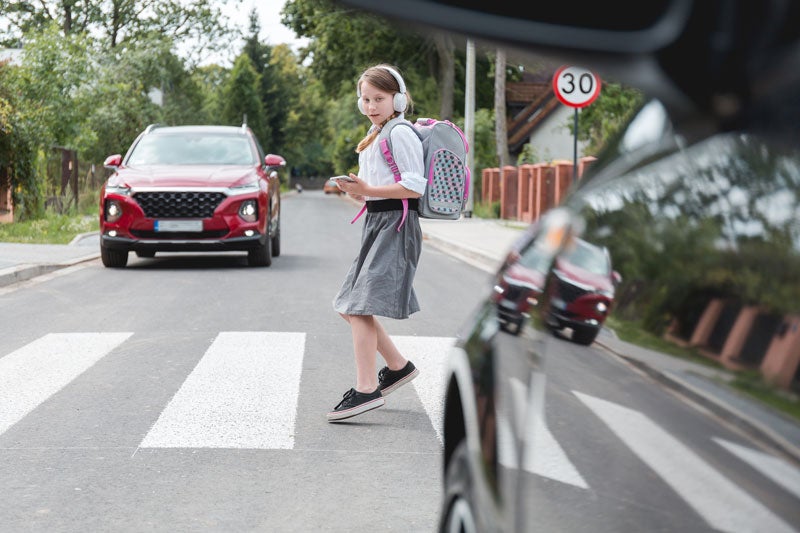
Two sections govern most mid-block crossings. Section 21954 requires a pedestrian outside any crosswalk to yield to vehicles close enough to be an immediate hazard. Section 21955 bars crossing outside a crosswalk between two adjacent intersections that both have signals or officers. Even so, subdivision (b) of section 21954 keeps the driver’s duty of due care toward anyone in the roadway. A mid-block crash puts both people’s conduct on the table, and fault divides by what each one could see and do.
What the Freedom to Walk Act Changed in 2023
The act added the same limit to a series of pedestrian sections, including 21950, 21954, 21955 and 21456. An officer may not stop a pedestrian for violating them unless a reasonably careful person would see an immediate danger of collision. Each amended section also says the change does not relieve the pedestrian of the duty of due care. Each one says the same about the driver’s duty.
Why a Report Without a Jaywalking Ticket Settles Nothing
Some injured walkers read a crash report with no citation as proof they did nothing wrong. The act governs police stops, not civil fault. An adjuster or a jury can still weigh a mid-block crossing under section 21954 when dividing blame. On the other side, the officer’s choice of a primary collision factor is a conclusion that photos and measurements can contradict.
Section 21955 and the Block Between Two Signals
Section 21955 applies only where the intersections at both ends of the block have signals or officers directing traffic. A block with a signal at one end and a stop sign at the other falls outside it. On a long stretch of Franklin Boulevard, that detail can change which rule an adjuster cites. Measurements from each corner to the point of impact settle the question.
Mid-Block Crosswalks Exist Only Where They Are Painted
Sacramento’s 2021 guidelines state that a mid-block crosswalk exists only where lines mark it. Once those lines are on the pavement, section 21950 applies in full, and the driver must yield. The city considers marking one where crossing demand is shown. It also looks at blocks with schools, parks or hospitals on both sides, where drivers have reason to expect people crossing.
The Driver’s Duty on a Dark Arterial
Vehicle Code section 22350, the basic speed law, bars any speed that is unreasonable for the visibility, the traffic and the road. A driver whose speed outran the headlights may have broken that rule even below the posted limit. The Office of Traffic Safety counted 438 fatal and injury crashes in Sacramento in 2023 between 9 p.m. and 3 a.m. That ranked the city second-worst of 15 for nighttime crashes. Insurers often point to dark clothing after a night crash, and streetlight outages, headlight range and speed answer that argument.
Sidewalk, Driveway and Parking Lot Crashes a Sacramento Pedestrian Injury Lawyer Investigates
A driver noses out of a coffee drive-through onto Arden Way, looks left for a gap, and hits a woman walking on the sidewalk from the right. Vehicle Code section 21952 required that driver to yield to any pedestrian approaching on the sidewalk before driving onto it. Section 21663 allows a car on a sidewalk only as needed to enter or leave adjacent property.
An insurer has a harder time blaming someone who was on a sidewalk. Vehicle Code section 555 defines the sidewalk as the part of the highway set apart for pedestrian travel. Bikes and e-bikes there follow a different set of rules, covered in the firm’s article on e-bike collisions on Sacramento sidewalks.
Driveway Backovers at Homes and Businesses
Vehicle Code section 21804 requires a driver leaving private property or an alley to yield to traffic close enough to be an immediate hazard. Section 620 counts pedestrians as traffic, so that duty can cover people on the sidewalk. Section 22106 bars backing on a highway until it can be done with reasonable safety. Small children can sit entirely below the view through a rear window, so mirrors, cameras and a walk around the car all matter.
Cars That Jump the Curb
When a car leaves the road and hits someone on a sidewalk or at a storefront, the question becomes why. Speed, impairment and distraction point back at the driver. A brake or accelerator defect can bring in the vehicle maker or a repair shop. A driver who blames a sudden medical episode will face questions about earlier symptoms and medical records.
Parking Lots Follow Different Rules Than City Streets
Under section 21001, most of the Vehicle Code’s rules of the road apply only on highways. Section 360 defines a highway as a place publicly maintained and open to the public for vehicle travel. A privately owned shopping center lot usually falls outside that definition. A city or county can apply the basic speed law and a few other sections to private lots by ordinance under section 21107.8. Otherwise, the claim rests on Civil Code section 1714, which holds people liable when their failure to use ordinary care injures someone else.
Drivers Backing Out of a Space
A driver backing out of a space has to watch for people walking behind the car. Civil Code section 1714 measures that driver by ordinary care, and a backup camera does not replace looking. Store security cameras often cover parking aisles from above. Ask the manager in writing to keep the footage, and note where each camera points.
When the Lot Owner Shares Responsibility
Lot design and upkeep can contribute to a crash. Burned-out lights and faded walkway markings are conditions the owner controls. So are blind corners at store entrances. Section 1714 covers the management of property as well as personal conduct, and a claim against the owner follows the rules for Sacramento premises liability cases.
Winning serious victories for our clients
- $6,000,000 Motorcycle Accident
- $5,000,000 Construction Site Accident
- $3,200,000 Rear End Collision
- $2,500,000 Apartment Fire Accident
- $2,500,000 Apartment Fire with Severe Burns
- $1,000,000 Rear End Freeway Collision
- $1,000,000 Rideshare Head-On Collision
- $1,000,000 Rideshare Accident with Back Injury
- $400,000 Pedestrian Hit in Crosswalk
- $300,000 Side Impact Collision
- $300,000 Big Rig Rear-Ended Passenger Vehicle
- $240,000 Motorcycle vs. Automobile
Past results do not guarantee or predict a similar outcome in any future case. Every case depends on its own facts and the law that applies to it.
What a Sacramento Pedestrian Accident Attorney Checks After a Light Rail or Bus Stop Crash
How a Sacramento Pedestrian Accident Lawyer Handles a School Zone Crash Involving a Child
In 2023, city crashes killed or injured 20 pedestrians under age 15, according to the Office of Traffic Safety. That ranked Sacramento fourth-worst of 15 large cities for child pedestrian victims. The countywide total reached 55 children.

Sacramento acted on school zones years ago. On June 4, 2019, the City Council approved a 15-mph limit near 115 public, private and charter schools. The change covered 225 two-lane residential streets that had carried limits of 25 or 30 mph. The city’s Vision Zero summary now lists 17 school-zone safety improvements as well.
Speed Limits Near Sacramento Schools
Two Vehicle Code sections set school zone speeds, and the street and its signs decide which one applies. A driver who ignored either limit hands the family a statutory argument under Evidence Code section 669. Photograph the posted signs and their distance from the school grounds the same week. Signs get replaced and moved, and the version standing on the day of the crash is the one that counts.
When the School Limit Drops to 25 MPH
Vehicle Code section 22352 sets the limit at 25 mph when approaching or passing a school posted with a standard SCHOOL warning sign. It applies while children are going to or leaving school during school hours or the noon recess. The same limit covers unfenced school grounds while children are using them. Those warning signs can stand up to 500 feet from the grounds.
Where Sacramento Set School Zones at 15 MPH
Section 22358.4 lets a city lower a school zone limit to 15 mph on a residential street with no more than two lanes. The posted limit there must be 30 mph or less. Sacramento used that authority in 2019. A driver doing 25 past an elementary school on one of those streets at drop-off time was 10 mph over the limit, even if 25 felt normal.
Crossing Guards and Stopped School Buses
Vehicle Code section 2815 makes it an infraction to disregard a uniformed school crossing guard who is protecting someone crossing near a school. Section 22454 requires drivers to stop for a school bus showing flashing red lights and a stop arm while children load or unload. The duty runs in both directions, unless the bus is on the other roadway of a divided or multiple-lane highway. Subdivision (d) extends the rule to roadways on private property.
How Fault Works When the Pedestrian Is a Child
Picture a 9-year-old who runs ahead after a crossing guard waves the group across, while a driver rolls through at 22 mph where the limit is 15. The insurer may argue the child darted out. If the child broke a pedestrian rule, Evidence Code section 669 lets the child rebut the presumption of negligence with proof of the care children of the same maturity and capacity ordinarily use. A child is not held to an adult’s judgment. A judge of the Sacramento County Superior Court must also sign off before a child’s claim can settle.
Tell a Sacramento Pedestrian Accident Lawyer Exactly Where You Were Hit
The place you were standing is the first fact to lock down, and it fades fastest. Crosswalk paint gets redone, parked cars move and video systems overwrite their files. A short call now keeps those details from slipping away.
Kreeger Law Firm offers a free consultation to anyone hurt while walking in Sacramento and to families who lost someone in a pedestrian crash. Chris Kreeger holds a 10.0 Superb rating on Avvo. He can also appear in federal court, with admissions to the Ninth Circuit Court of Appeals and to the federal trial court for the Eastern District of California. He will review the crash location, the report and every policy that might pay, including yours. Most California injury lawsuits must be filed within two years, and no lawyer can promise how a claim will end.
Kreeger Law Firm collects an attorney fee only if Chris recovers money on your claim. The firm fronts every case cost, and if the claim brings in no money, you pay none of those costs. Staff members who speak Spanish are available when you call.
Were you hit in a crosswalk, on a sidewalk or at a transit stop? Call (916) 782-8400 today, or describe the crash on the firm’s contact page for a Sacramento pedestrian accident lawyer to review.
Other Injury Cases Chris Kreeger Handles in Sacramento
Kreeger Law Firm also represents people hurt in these Sacramento crashes and injury claims.